The Chase is Always Better Than the Kill
19.12.09
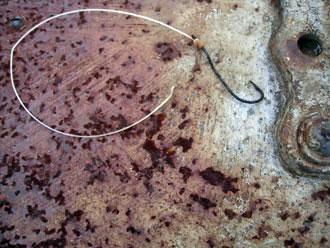 I confessed to my girlfriend via text message that I was probably the worst fisherman I knew. I’d just completed a trifecta of fishing ignominy—lost one lure, then another, then three snags on five casts inside of ten minutes. It was a gray, heavy day. “I don’t think I’m supposed to be a fisherman,” I wrote her. I sneaked through a fence behind a Con Ed power plant and looked out across the river to the gray city, a screeching sound through the guides on my rod. The wind was howling across the East River from the west at 30 miles an hour, and the green water was rushing downstream and swirling in hurricane-like patterns on the surface, hammering the bulkhead below me and splashing and foaming aggressively. I was completely miserable but determined to catch a fish. To my left was a barbed wire fence covered in fishing line and rusted tackle, like the Kite Eating Tree in those Charlie Brown comics. All over the ground was broken glass and old hooks with snell knots still attached. An empty bag of chips whipped past me and the water beckoned hungrily. She texted back “Sounds like you’re casting into a pit of despair.” She was so right.
This is how I spent most of the month-or-so-long Brooklyn Fishing Derby: like an extended episode of Fishing With John, the critically acclaimed series starring John Lurie fishing with celebrity guests in which all scenes of actually catching fish are edited out. Here I was, religiously fishing for the first time in more than 15 years, searching for I-don’t-know-what out of the Brooklyn side of the East River for a story I proposed to Casey in the beginning of October, romanticizing this idea of nothingness—the seeming opposite of the types of personal stories in Harpers and the New Yorker in which the author struggles to shoot that first buffalo or nail down that dodgy interview, and eventually succeeds. I was entertaining a somewhat different outcome to this story, however—what if the author set out on this quest to learn something new and discover something about themselves, set about to write about his experiences and devoted a month or more chasing this story, daily taking copious notes, and then found in the end he had nothing to write about, except, perhaps, that he was a terrible fisherman? Because three-and-a-half weeks into the derby, I hadn’t had a single bite.
I first heard about the Brooklyn Fishing Derby from the posters that popped up around the neighborhood where I work. Williamsburg being the hipster epicenter of every awful trend of the last seven to ten years, endlessly and ruthlessly co-opting other people’s ways of living and making an ironic hat out of it, I figured the posters had to be some kind of hipster prank. One Saturday while walking to the subway I passed by the fishing derby booth. It was three guys sitting at a card table with a pile of photocopied applications and posters in front of them. Some of the applications had ink written on them. Although my initial contact with the derby people was brief and fleeting, I studied the mental image closely on the train ride into the city, walked distractedly with my girlfriend through Chinatown until she finally said “Well, you may as well go back and talk to them.” My girlfriend, whose father’s side of the family are all fishermen and hunters, was very gracious.
It was late in the day when we got back to the derby booth on Bedford Avenue. The three guys were still there and I grabbed a couple applications, already plotting to team-up with a friend who was living for a long time on my couch. Two of the guys, one with a beard and another who reminded me slightly of a young Tom Waits circa The Cotton Club formed the Brooklyn Urban Anglers Association over the summer in order to organize events such as this one. I asked them a couple customary questions, like the rules about judging fish. It all turned out to be very informal: there were four eligible fish species—striped bass, bluefish, bonito, and false albacore. The derby was all catch and release. If you caught a fish you would submit a digital photo or video via email. You were supposed to hold a tape measure against the fish to indicate size. “Try to make it look real,” one of them said to me. “Like, don’t put a picture of a barracuda in it or anything.” Although it was officially called the Brooklyn Fishing Derby, spots like Sheepshead Bay weren’t eligible for the event. Instead the organizers opted for a stretch of the East River from the Valentino Pier in Red Hook, to the Gantry Pier in Long Island City, technically Queens, just across Newtown Creek, which is widely regarded as one of the most polluted bodies of water in the country. The East River, while probably not the first place a fisherman would choose to hunt big striped bass, was nonetheless a migratory route for these fish, with a strong tide, fast, deep water and plenty of man-made cover.
I took the applications still not wholly convinced the event would not be a self-celebratory hipster excuse to wear Bass Pro Shops hats and camouflage overalls, but the idea of getting back into fishing was starting to crank the dusty wheels in my head. The derby began October 1, which by chance was also the first day of a new state law requiring fishing licenses for all recreational saltwater anglers, and ran through the first week of November. Prizes were yet undetermined, and the derby rules appeared to be directly cut and paste from another, more organized, fishing derby, like the one held in Martha’s Vineyard held every year. That derby is the subject of David Kinney’s book The Big One: An Island, an Obsession, and The Furious Pursuit of a Great Fish, which, I imagined, would be like the adult version of this story, where dedicated, veteran fishermen ruin their marriages searching for that Big Fish. This story, I hoped would not be the one where we learned how to tie advanced clinch knots and tried not to hook ourselves. Maybe we’d catch something.
 I started fishing when I was pretty young, maybe 5 years old. My dad got me a small Zebco spincaster rod and reel combo and he’d take me fishing at these ponds outside of Rising Sun, Maryland. The funny thing about Rising Sun was that at one time it was considered the Ku Klux Klan capital of the country. In fact, if you start typing “Rising Sun Maryland” into Google, the first autosuggestion to complete the phrase is “Rising Sun Maryland KKK.” I couldn’t have known it at the time, but my dad had real balls taking me there; it probably wasn’t as bad1 as the time I made him take me to this monster truck car crush/tractor pull/dirt bike race at the Spectrum in Philadelphia, but it was still pretty courageous. Anyhow, I grew up catching bluegills and largemouth bass at these ponds. I remember doing some kind of report in first grade about the first bass I ever caught. I have on my wall in my apartment a stuffed bass I caught at those ponds when I was 8 or 9. It was 4 pounds and 11 ounces and I was convinced it was the biggest fish I would ever catch. I didn’t start fishing saltwater until I was older, about 14 or 15, when my dad was regularly fishing the Indian River Inlet in Delaware, but it wasn’t until recently that I caught anything out of there, despite all the pictures my dad has of the striped bass he’s caught over the years. I didn’t catch a striped bass until 2006, while fishing on Peaks Island in Maine with my cousin, with whom I usually used Cheetos as bait whenever we fished as kids. I caught a couple small ones, schoolies, well under the legal limit of 28 inches, but sleek and clean and a shiny white with grey stripes and shimmering black back. I caught them between smoke breaks—we had one rod, so my cousin would smoke while I fished and he would do the same.
I was getting anxious with October 1 rapidly approaching, but I still had no fishing gear since I had to run back to Delaware to borrow some from my dad that weekend. Over the years he had upgraded his gear to two $800 Van Staal reels and a few 8.5′ and 10′ St. Croix rods. All of the other rods, Fenwicks and other St. Croix rods, and reels like a new old-stock Fin-Nor Ahab #8 and the classic workhorse Penn 450ss and 550ss reels, he relegated to the basement. He also hoarded lures, often buying three or four of the same kind when he found one that worked. So there was a small trove waiting for me in their house in Delaware. Although I felt guilty taking his old gear, he seemed eager to unload it on me when he heard I was fishing again.
I went to the opening party for the derby the evening of October 1, partially to pickup the “derby package” which consisted of a t-shirt with a striped bass on it, a copy of the derby rules, a Brooklyn Urban Anglers Association membership card, and a tape measure, all neatly packed together. I also wanted to see if my hypothesis regarding the hipster nature of the contest was true—I was slightly nervous I’d paid $45 each for my friend and I to watch people drink Pabst Blue Ribbon and play dress-up Ernest Hemingway. Thankfully, I was wrong for the most part. When I walked through the door of Dream Fishing Tackle in Greenpoint I could see that the shop was all business. Fishing poles stacked against the right wall like cordwood, 11 and 12 feet long, freshwater and saltwater lures and tackle mixed along the racks, hooks sharp and shiny, beckoning, different prices for the same lures, a constant dribble sound of a fishtank somewhere in the back, photos of people holding big fish taped to a bulletin board, a little cat darting under people’s legs and in between boxes of reels, and there was a seductive and delicious smell of smoking fish whirling lazily through the air.
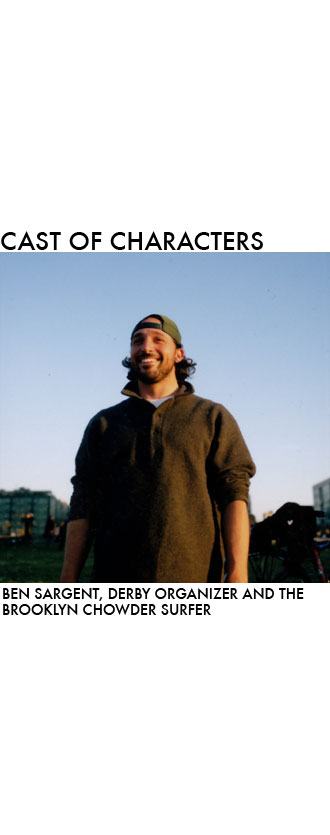
Earlier in the week I contacted Ben Sargent through the derby Web site and made some loose plans for an interview. Ben, along with his surfing buddy Jamie Potter—respectively the bearded and the Tom-Waits-ish characters I met the previous weekend—were the organizers of the derby and founding members of the BKUAA. For such a unique event in Williamsburg, I anticipated some light media attention, but again, I was wrong. Just after stepping through the front door and making my way toward the back yard where Sargent was finishing up with the smoked fish, I counted two reporters—one from the New York Times—and two documentary filmmakers. As the night went on, I counted three additional reporters from various local papers and Web sites. I finally caught up with Ben—filmmaker in tow—as he was carrying two big smoked fish, a blue fish and a striped bass both about 30 inches or more, from the grill. When I introduced myself he offered me an elbow. Unsure whether this was some kind of surfer or Brooklyn fishing brotherhood greeting, I gave him a soft pound on the extended chevron with my fist. He was clearly overwhelmed with derby stuff to do, as well as acting as the ambassador of the derby to the members who were slowly but steadily streaming in. Reporters converged on him at every turn of the little aisles in the shop and he was constantly followed by a guy with a camera with one of those mikes that look like a cucumber. Still he had a big grin on his face despite the hectic atmosphere. Looking at the other reporters and their notebooks, and looking at the only scrap of folded up paper I had brought, which I mysteriously had reserved for writing a friend in prison and some scribbled notes, I didn’t feel very professional. I made plans to interview Ben when things calmed down a little bit. I talked with a couple other derby members and eavesdropped on some conversations about fishing spots, making mental notes about a pier in Red Hook. I was glad to see my hipster hypothesis was mostly wrong—the derby was beginning to take shape with some dedicated veterans, and a lot of inexperienced but nonetheless enthusiastic neophytes. As I left I waved goodbye to Jamie Potter and shop owner Robert Piskorski. “Welcome aboard,” Jamie said.
1 Fishing, I’ve found over the years, is like Metallica—a great equalizer among disparate people.
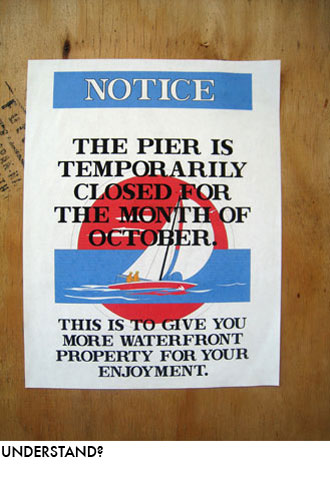
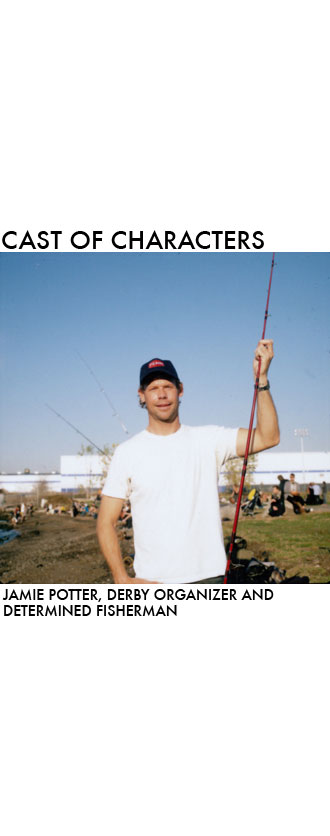 Ben, as it turned out, was a man of some renown in the cooking and surfing world. He’s famous for his chowders, recipes he learned from his grandfather Frank Sargent who lived in Cape Cod. Ben has cooked chowder for Martha Stewart and Bobby Flay and owned a couple seafood restaurants in Williamsburg. The “Brooklyn Chowder Surfer,” as he likes to call himself, has a Web show called “Catch It, Cook It, Eat It,” and he travels around the world finding sea-worthy characters and secret recipes for delicious fish and seafood. He’s recently expanded that series into a weekly show on Heritage Radio. He’s a man of seemingly unlimited energy and of packed schedule, always in the middle of two or three things at a time. I met him a few days later by the new pier at the end of North 5th Street, which is nestled among huge expensive condos and you literally walk under one like a giant tollbooth in order to reach the water. The pier, which was open just a few days earlier for the first official Sunday meetup for the derby, was now mysteriously boarded and locked shut. Ben was wearing the same Katz’s Deli hat backwards and same camouflage pants as the opening night party, and was busy talking on his cell phone while filming himself Survivor Man style as he spoke. He greeted me again with an elbow. “This fucking sucks, dude,” he said. The NYC Parks department, in their ultimate wisdom, had decided to close the pier for the month, probably the last month of the year that anyone would actually care to be on the water. A paper sign was nailed to the board: “Closed in order to provide you with more waterfront enjoyment.” I didn’t have much time to interview before I had to head back to work, so again I made tentative plans with Ben for later that week. As I crossed Kent Street I heard a voice talking over the wind. It was Ben riding a crappy ten-speed bike, a huge Lowepro camera bag on his back, two fishing rods strapped to the pack, one hand on the handlebars and the other hand holding the camera filming himself as he rode up the street.
By pure coincidence, the start of the derby coincided with the introduction of mandatory fishing licenses for all recreational saltwater fishermen in New York state. Freshwater and commercial anglers have long been required to buy yearly licenses, but for the salty surf fishermen, this was something new and viewed almost universally with suspicion, with few people I spoke to willing to shell out the $10 annual fee. The new law was the result of a federal policy made after the reauthorization in 2006 of the Magnuson-Stevens Act, the primary law that manages marine fisheries, when the National Oceanic and Atmospheric Administration (NOAA) found its current survey methods inaccurate. The old methods consisted of cold-calling residents of popular fishing towns as well as a “shore based angler intercept survey,” which many on Internet fishing boards joked was a Department of Environmental Conservation (DEC) agent estimating a catch by counting the number of anglers on a pier or jetty. Now with the new policy requiring improved data collection and accuracy over the marine fisheries, states began issuing mandatory licenses for saltwater anglers before the federal registry takes effect in 2011. The reason is simple: the U.S. government requires a registry of all saltwater fishermen across the country. If states don’t issue their own licenses and gather the registry information themselves, the government will issue a federal registration for $15-$35, meaning that money collected from saltwater licenses will go to a federal coffer rather than a state one.
Saltwater anglers have been in a state of semi-chaotic revolt since October 1. Some East End towns on Long Island have collectively filed suit against the DEC citing the Dongan Patent, a pre-Revolutionary War document which grants power over the town’s waterways and public lands to locally elected trustees. Originally brokered between Governor Thomas Dongan and the British government, the New York state constitution preserved the patent even though it was part of colonial rule. Brian Foley, a senator from Brookhaven is sponsoring a bill known as S6250 which will repeal the license mandate, and instead participate in a “free federal registry”—which the government hopes will be agreeable to the East End towns. Many anglers flatly refused to purchase a license, citing the state’s general ineptitude in managing money. Anglers want the money to go back to fisheries management and improvement and worry the fees will go into a general state fund. Of the 60 or so derby members, few made the effort to get a license, which was clearly not endorsed by the organizers of the derby. “It’s now a privilege to go fishing,” Ben told the Daily News in October. “They’re only doing this to make money on licenses and to make money on ticketing you.” Jamie echoed the sentiment, shrugging “It’s just another barrier for people who live in a big borough to get out and enjoy fishing.”
 I spent the first few days of the derby doing reconnaissance, scouting out potential fishing spots along the East River. While I’d eavesdropped good things about Valentino Pier in Red Hook, I thought it was too far to get to without a car. To the north was Gantry Pier and already there were rumors floating about someone in the derby who’d caught a 40-inch striper the first weekend. However, I focused mainly on the stretch of the river I could reach feasibly by bike and close enough so I could fish before and after work. Not so long ago there were many access points in Williamsburg, mostly of the surreptitious variety that required hopping fences or looking for a hidden but well-travelled path through the trees or grass. But here in 2009, the Williamsburgh waterfront has finally given way to developers and order. The East River Park, once a junkyard for trash, abandoned cars, and homeless camps, is now a playground for Williamsburg hipsters2 and flocks of geese, which leave their plentiful stool en masse camouflaged in the grass or simply piled neatly and high on the concrete. More importantly though, despite its enticing 80 yards or so of waterfront, there’s now a tall fence surrounding it restricting access to that waterfront. To its left is one of the biggest condominium projects in the neighborhood: the 1000-unit Edge and Northside Pier condos, each of the three hulking shimmering towers casting long shadows in the afternoon. This too was once “publicly” accessible land. But like the fate of the nearby North 5th Pier (one walks under a Northside Pier building to get to the pier), this area is also now closed to the rabble (though it will supposedly “reopen” when the condos are finished being built3), and it’s all but a matter of time until more property is swallowed up by new development. I decided to bypass the piers and parks, figuring most derby members would focus on them. Instead, years of sneaking around in covert, nighttime operations told me there were other less obvious places that would produce just as well, if not better. I might have to walk through some trash or scale razor wire, but old, dilapidated and forgotten Williamsburg was still there. And in the city, the hobos will always find the best fishing spots.
I decided to head to an end street my first night out. There are some streets that end literally at the water’s edge, with only a curb and maybe a barrier to keep one from drunk driving into the river. I picked this particular street because the aforesaid hobos had set up camp at another spot a block away, and the previous night while attempting to fish, I was shouted out of there by a couple obnoxious drunks mistaking shadows for ghosts. This street, cobblestoned and lined with broken glass, weeds, and old sleeping bags, was a popular spot to do drugs and bring prostitutes, even if it was occasionally patrolled by police. Kevin, my friend who stayed on my couch for a long time, and my brother came along. We cut an intimidating presence at first, pulling rods and plastic bags full of beer out of Kevin’s car, or at least we thought so since everyone who was hanging out at the end of the street left as we arrived. “Maybe we should just vibe everyone like we’re going to rob them,” Kevin said. “Then they’ll all leave hahaha.” I should have known something was amiss with my team-fishing idea when I saw Kevin’s setup, which was a four-and-a-half foot spincast combo, like the one I used when I was 5. Not good for hooking into a striped bass on the river. He was also using flies. I hooked up a bucktail and sent a short but respectable first cast into the dark river. About 20 feet out I hung up on something, a rock, trash, grass, or industrial waste. “What the hell,” I muttered. “First cast?” If only I knew it would be the first of many many more.
Kevin on the other hand was busy trying to figure out how to cast. My brother was perched on the concrete barrier drinking beer. It took me a few minutes to break off and another five to re-tie my line. Kevin was having trouble with the wind: every time he’d try to cast the wind would blow it back in his face and he’d lose sight of the fly somewhere behind him. My second cast was uneventful, though I was thankful I didn’t lose the lure. My third cast changed that for me. After ten minutes our collective track record went like this: three casts for me, two lost lures. Kevin I’m not sure got his line in the water. “This place is too rocky or something,” I said, cracking open another beer. Kevin was already on his third. Drinking beer was the only comfort on this brisk fall night, with the full view of the city ours for the taking, at least until a Hasidic Jew pulled up with a faint female shadow in the passenger seat. He stayed there for another couple beers worth. A little feral cat ran past us under a rusty fence. Our first night was a complete and utter hilarious failure. Later while writing in my notebook, I scribbled: “Realization that I looked close to what I wanted at the beginning: bum fishermen in a shady fishing spot. Looking crazy and dangerous. Drinking cheap beer and feelin’ good. Just needed a 50-gallon drum with some fire in it. Not a total loss.”
2One of the trademarks of hipsterdom is, of course, believing one’s self to be somehow outside the group designation of “hipster.” For example, towards the end of the derby while catching a ride home with Ben he told me, “Robert was asking me about you today at the shop. He just couldn’t believe a hipster kid could fish.”
3As of this writing (December), the pier is still closed.
 The rumors of the 40-inch fish were true. I found out while listening to Ben’s first “Catch It, Cook It, Eat It” radio show. The show featured three guests: “Salty fishermen of the East River,” Ben told me via telephone while we rearranged yet again an interview time. Of the guests, John Ruffino, a gregarious and excitable, loud-voiced Brooklynite, was the man responsible for catching what would surely be the biggest fish of the derby, before I even put a line in the water. Robert Piskorski, the owner of Dream Fishing Tackle was there as well as Greg, the owner of a local pizzeria. Ben focused his first episode on the newly implemented fishing licenses, and asked for his guests opinions, none of which were close to positive.
“I don’t have a license,” John began in his thorough Brooklyn accent. “I’m not going to pay $10. I’m not going to pay no money. I think it’s unfair because it pushes out all the bums. The bums aren’t going to spend $10. They want $10 to buy food or beer or whatever. It’s like elimination in the fishing game. And then they keep tabs on you, the government. Even if you don’t keep the fish or even catch one. They want you to pay $10 and I don’t even catch one?”
Robert took over. Except for a few syntax issues, Robert’s Polish-accented English is quite good. “Ten dollars that’s not what it’s all about. You just don’t realize that October 1, saltwater fishing in New York became a privilege. It’s written on a green piece of a paper and you pay ten bucks for a privilege. That means this privilege they can take it away from you,” he said. Robert in his own act of protest doesn’t carry the new saltwater license, jokingly explaining he tells his customers to go ask the Post Office instead.
“Rob, you’re telling me they’re going to tell me I can’t fish?” John asked.
“If you are a bad boy the privilege is taken away from you. They have you in the computer. If you catch a fish an inch shorter or inch longer or whatever. You litter. You fish with bait when you’re supposed to be fly fishing. They’re going to write you a ticket but they can also revoke your license. Fishing license is becoming like a driver’s license which can be revoked at any time.”
“So they can trace you now,” Ben said.
“Exactly, because it’s your name attached to the number [on the license],” Robert said.
“The government! Like I was saying before!” John shouted.
Greg, who had been quiet up until this point, commented about the expanding role of the government and how everyone knows they’re taking more and more control of people’s lives, but nobody does anything about it.
“It’s not just that,” Robert said. “They want us to fish where they want us to fish. We can’t fish where we want to fish.”
 Access is a sensitive subject for fishermen, perhaps even more so than the license debate. Nowhere did anti-government sentiment simmer more restlessly than the little tackle shop in Greenpoint. I went to see Robert after the first few fruitless fishing outings, both to see if he knew about other viable night fishing spots and to pick up more lures and tackle since at this point I was losing an average of four lures a night.
“I don’t know anymore,” he said with a sigh. “I used to fish a nice spot but now they get you for trespassing sometimes. 17 years ago when I opened the shop there was access all over. People were free to go anywhere to fish. But now the police are like taxman but in police uniform. They have to make their money, that’s all they care about. So now there is no place to fish.
“It’s a huge problem,” he continued, sitting back in his chair behind the messy counter. “[The city] wants us to fish the north end of Brooklyn and Queens, but there are so few places now. They listen to the property owners and kick the fishermen out.”
A particular point of enmity with Robert is shore fishing, where the city or the state will make a media event about a new area for fishermen in one breath, then close prime and venerable shorelines to fishing in the next. “They open one pier, they’re showing it on the TV and talking about providing access [to the water] for the people and meanwhile they’re closing off 20 miles of shoreline to fishing,” he said, slapping the back of one hand into the palm of the other. “Then they put you in a spot with like 500 other people. Who the fuck wants to do that?”
A few days later I decided to check out one of the old spots Robert talked about. I got off work early with about an hour of daylight left and headed out on my bike to do some more reconnaissance. That first night of disastrous-but-humorous-results I saw several blocks down an abandoned pier stretching out into the river. It was clearly unusable, and it looked like much of the walkway was sitting in the water or rapidly falling apart. The pillars appeared to be sticking up out of the water, free from any necessary encumbrance like a plank of wood. Even if the pier was dilapidated, I still thought it would provide some good cover for fish. I told Kevin that one night—the only night he came out to fish: “I think we can climb this fence, run alongside this building, sneak through that far fence somehow and we could get pretty close to that pier.” It was unnecessarily complicated and daring, because as I rode up to the spot Robert told me about, there was a driveway that lead all the way to the water and ended a few hundred feet away from the pier. The river seemed to slow down around here, and it cut into a tiny cove amongst no small amount of industrial trash, mostly piles of concrete. There were already two guys fishing on the concrete platform at the end of the street and they greeted me with some unease, but eventually relaxed. This part of the driveway was tucked well away from the main streets and there was no shortage of shady characters coming and going back here, like the guy I passed on my way in who was trying to hot wire a stolen pickup truck. The two guys fishing were older, one significantly older than the other, and at first they hesitated as if they didn’t speak English. It turned out the younger one spoke English fine, but the older one did not.
“How’s the fishing going?” I asked.
“Okay. Nothing yet. Maybe too early,” the younger one said. They were fishing with clams, their lines casted out into the little inlet between the decaying pier and what appeared to be a half-sunken twisted wreck of a steel bridge. They had little bells clipped to the tips of their rods, so they just stood around waiting for a jingle to tell them a fish was on the line, and occasionally reeling in to make sure the bait was still on the hook.
I told him I just started fishing the East River and asked if this was a good spot to fish.
“Yeah, it can be good,” he said. “The biggest I’ve caught here is a 33-incher. Another guy caught a 46-incher here.”
“Thirty-three is a pretty good fish though,” I said.
“Yeah, it was a pig,” he said. “But can you imagine the 46-incher…”
We talked a little longer and it was starting to get dark. The guy trying to start the truck was still back there and I wanted to get out of there before he started asking me for spare change or something. I asked the guy fishing about bait versus lures, since lures were all I’d been using/losing so far.
“They work pretty good.” Then he smiled, “But then you gotta… ehhhhh,” he said, miming casting and reeling in over and over again. I laughed. The repetitive nature of casting over and over could get tiring, especially when you aren’t catching anything. It was a feeling I was getting to know pretty well. I wished them luck and got back on my bike. On my way out, the guy trying to steal the truck asked me if he “could borrow five bucks until tomorrow.”
 A week later I still hadn’t caught up to interview Ben. We made plans to talk Sunday at the weekly Derby meetup at the East River Park on North 8th. I woke up to a cold, brutal, and completely unrelenting wind, geared up and and rode my bike to the park. No one from the derby was there, and neither was anyone else. All there was was cold, choppy water, gray sky, and a silent city across the river. I headed a few blocks down to another smaller park where piles of large rocks met the river. The water was faster and deeper here. I promptly lost two lures on three casts. That’s when I texted my girlfriend about my miserable fishing skills. I was about to leave after 10 minutes, but then my eyes spied the deadly barbed wire/Kite Eating Tree on the corner of an old concrete dock. I panned slowly to the right, following the chain-link fencing down the line to another corner, where I saw a small hole in the fence. Big enough to slip through, but camouflaged to remain somewhat hidden. It was like someone had peeled the corner back from the post and then let it go, resting against the metal but no longer attached. I slipped behind a Con Ed power plant, noting that technically the “No Trespassing” sign was on their inner fence, and not this one. It lead to a concrete dock about 100 feet long, 20 feet wide and a buffer of weeds, then the back fence of the power plant. Occasionally a security guy would pop his hardhatted head over the fence, but seeing some stupid idiot out on the dock on a day like this, perhaps he relented because he allowed me to stay out there freezing for a few hours.
Out here is where the wind really kicked up. Forty mile an hour gusts feeling like a post-apocalyptic gale. It bordered on cruel. I checked my watch: 3:15. Dead low tide was in an hour and I wanted to fish an hour after that. 5pm seemed a long ways off. Cast after cast with no fish, but the water was even deeper here so at least I wasn’t losing any lures, I told myself. This was about as close as I’d gotten to the main channel of the river and I could see about 150 feet out past a rickety looking catwalk that water hurtling itself downriver, and the water below me swirling into weird and violent weather patterns. It seemed like a good spot to fish, given the amount of water moving through here, but nothing was biting. I steeled myself and tried obstinately to defy nature. By either miracle or stupidity I made it to 4:30, when I called it. I rode home into a strong head wind and passed out from shivering for a couple hours. When I woke up there was a text from Ben. “Fishing called off due to wind!” Smarter guy than me.
I went to Robert’s shop a few days later to replace the soft-plastic shad baits I kept losing. This is where I met Greg, the owner of the pizzeria who was on Ben’s radio show. He was busy smoking cigarettes and getting yelled at by Robert and his mother. “Greg, you have to fix the sign in front of your store! You have no customers!” “I know, I know, I know…” he said, ashing into a plastic cup, as if his parents were chastising him. I recognized Greg’s voice from Ben’s radio show. He’s younger than I imagined, has close cropped hair and was wearing a T-shirt that read “Native Americans: Should’ve Fought Harder, Pussies.” While I don’t agree with the message, I do agree with the medium (upon knowing Greg, I don’t think he agrees with the message either, but the medium, for sure). Greg is a hardcore fisherman, and though he wasn’t part of the derby, he was highly affiliated. He was also one of the first openly generous fishermen I met, giving me productive fishing spots and fish-catching techniques without reservation. I was surprised by his openness and grateful for the tips. Greg is also a fearless fisherman, as I would later learn from Robert, who told me, “Greg is crazy. He says ‘You want to go over here? No problem. You want to climb over this fence? No problem.'” He also has some connections that make it a little easier for him to fish. For example he told me about a spot near Carroll Gardens by the Brooklyn Queens Expressway. From the freeway it looks like an empty lot of concrete piers, inside of which no one is allowed.
“You can’t get there unless you talk to the security guard or construction workers,” he said. “I know one of the security guards for one of the construction companies. You look at it and what happens is the concrete pilings, because you see the way they have it built off the land? Those docks, you’re talking 10,000 square feet of manmade concrete piling docks. And what happens is all the baitfish look for structure naturally, this river has no natural structure, except for manmade. That whole strip there if you can get in there where they’re doing that construction over there, you can fish off that. You don’t even need to cast [to catch fish]. But, it’s just getting in there.”
 “People don’t realize this,” he began. “Commercial fishing takes all of the fish out of the water. Recreational fishing does little to no damage to the fish populations of the world. And this is fact, this is just pure fact. They’ve studied this extensively. What’s going on now is, it’s a combination of all different governmental agencies who want money. They can never get enough of it. Why, well we all know about wasteful spending. But what they’re realizing is that fishing is a big business and it’s basically disposable income that people are using. And what happens is, you see a lot of guys that go fishing; I’d say probably 50 percent plus are below-middle income people. And what happens is these people don’t really have extra money but they spend money to go fishing. And what they’re realizing is that people like to fish, it doesn’t matter what you do, they’ll pay the piper. People grumble, they complain but they’re still going to pay.”
While it’s true most people I’ve come across while doing recon for fishing spots have been “below-middle income” (myself included) I believed most of them are the more likely ones to fly below the radar. Fishing spots like the ones at the end of shady avenues, climbing fences after dark, or sneaking past security or surveillance video cameras aren’t really the types of places the DEC agents are likely to patrol. Still, the DEC fines can range from $500 to confiscating your gear, of which easily $500+ could be taken. That’s the real worry with fishermen: that some part of their livelihood is being taken away by this new restriction, nominal fee notwithstanding, but on pure principle. Like John Ruffino said, most of the bums want to spend that $10 on beers or food, but for most recreational anglers, $10 is a beer and half at the bar, or three gallons of gas. For the bums, it’s more of an issue of access to water, which is also being constricted, especially in this neighborhood.
“The thing is the thing with no access, it’s nonsense. There’s no real good reason for it. [But] it’s really people are getting what’s coming to them for them being idiots, collectively as fisherman. The reason a lot of people keep people out is, and I know this from a lot of guys that we know that will let us fish in certain spots, is that it’s garbage [i.e. fishermen leave garbage]. You see fuckin’ garbage everywhere. You see styrofoam containers for the worms, everything else. When I go half the time I bring a garbage bag and end up leaving with 2 days worth of crap from other people.
(At this point the recording is interrupted by Robert shouting into the phone: “I HAVE SOME WORMS BUT USE BUNKER! BUNKER! I CAN’T UNDERSTAND WHAT YOU’RE SAYING!”)
“If everybody collectively came together and didn’t let this shit go on—you see somebody littering on a pier—it’s one of those things that if everyone else on the pier sits there and makes the person feel like an asshole, they’re not going to do it. Even the people drinking. You know, you want to drink, fine. Just don’ t throw your fucking bottle in the water. You know they came in a case or a carton or you brought a bag with you. You walk in, you can carry it out. That’s really what it comes down to.”
 Greg makes good points about the government trying to make money from the new saltwater licenses, as did most other fishermen I spoke to, and very good points about people leaving various detritus behind when fishing. Even when I finally caught up later that week with Ben for a brief interview that was cut short by the jingling of bells, a hit on his line, he told me he didn’t trust the government’s motives for issuing the licenses. “I think my biggest problem with it is I don’t understand it. Are they trying to regulate fish populations or are they trying to regulate us?” he said. “I don’t know if they’re trying to keep tabs on people because as far as i know, the number of people who are fishing here, are really not enough to make a dent.
“Not that recreational fishing isn’t a problem. I believe in regulations and I believe in trying to have some understanding of how many fish are being caught. But it doesn’t really seem like the problems with overfishing have anything to do with the individual fisherman. And it seems especially unfair that fishing is this nice thing that you can come outside to do, that’s not controlled and not over-regulated and is a really nice escape. And not only are they making you buy this license, but they’re getting your information. And that’s annoying.”
Though hardly anyone trusts the government to spend money appropriately, I decided to do some due diligence and contacted the DEC office in Albany via email. I got one of those automated email responses back that read, “Thank you for contacting the Department of Environmental Conservation. Here are the most popular answers to your question… Did this answer your question?” Of course, they never do. Fortunately, someone named Wallace “Wally” John responded back with a quick missive: “Out of the office today but will call you Monday with details.”
I got John on the phone on Tuesday. He’s worked for the DEC for a little over two years, but spent 24 years in the New York State Assembly working on environmental policy. He seemed quite knowledgable about all aspects surrounding the license debate and the controversy and rebellion. But I first asked him to give me the DEC’s perspective, since all I had at this point was news articles and personal accounts of fishermen who felt betrayed by the state.
“We see this as an opportunity to develop a better database for our own programs,” John said. “Our objectives are essentially the same as the [federal registry]. What we found were their survey methods were sub par: essentially what they did was randomly call people in marine towns and ask “Did you fish?” And they either say no or yes, but it’s random. They might fish or they might not fish. We don’t waste time with this if we’re using the registry.”
The surveys, he explained, were trying to determine the extent of what the recreational catch is of the species of marine fish out there. What worried most fishermen I talked to was the licenses would lead to more regulation, that the DEC would mismanage the information and cut their seasons short. But what John said is that the current data system is so unsound that New York fishermen are already at a disadvantage.
“One of the arguments the DEC has made is the distribution data is already so flawed, the data is so bad that setting bag limits and quotas in New York based on this data is unfair,” he said. “The federal government has the ability to shut down any fishery they want based on the data which is inherently dubious as to the accuracy. Nine other states have better distribution data than us and New York anglers are essentially being punished because of this lack of data. That’s the driving force.”
 For example, in 2008 the DEC filed suit against the U.S. Commerce Department, the National Oceanic and Atmospheric Administration, and the National Marine Fisheries Service, stating the agencies used “flawed data” from the 1998 fishing season to set unfair limits on fluke fishing in New York, without considering changes in population and harvesting patterns over the past 10 years. New York was also “saddled with a disproportionate burden of the federal plan for the fluke’s recovery. For instance, an angler on the New York side of Raritan Bay can land four fluke per day that must be at least 20.5 inches long, while someone on the New Jersey side of the bay can land eight fish that only have to be 18 inches long.”
Another important point, John said, is that if New York instead opts for the federal option, anglers would still have to register with the feds and pay $15-$35 a year after 2011, and none of that money will go to marine programs, either for the state or for the federal government. The state would still be responsible for collecting the data and providing it to the government, it’s just that the money required for surveys and data collection would come from somewhere else, like the state freshwater and hunting license funds. “If we did it for the federal government that would be a cost to us and someone else would have to eat part of the cost, or we will have to lose programs and staff” he said. Under the bill sponsored by Brian Foley, bill S6250, the state would ostensibly be responsible for even more since the bill aims to create a “free registry” for saltwater fishermen, meaning more cut programs or siphoning funds from somewhere else other than those that would be provided by saltwater license.
The DEC estimates the number of saltwater anglers in New York to be between 200,000 and 300,000. They targeted $3 million in license revenue. So far John said they’ve collected about $1.35 million in fees and sold about 60,000 licenses. The money from the licenses will go into a marine reserve account, he explained, along with money collected from crab, clam, and commercial licenses. The account is then used for various programs like marine habitat protection and shellfish study, as well as administrative costs.
This lack of participation in the license program is significant, John said. One of the issues anglers resented most was having to pay $10 for a license in October, then having to shell out another $10 in January. John said for the most part the DEC has tried to increase awareness of the program for the first three months and has not been issuing fines or confiscating equipment. “We hope next April, late May to gradually increase the degree of enforcement activity,” he said. “There’s very little enforcement activity in the East End towns because of the lawsuit, and if we can’t really enforce it there then it’s unfair to enforce it anywhere.”
When I asked him about the validity of the East End town’s argument citing the Dongan Patent, the pre-Revolutionary War document that gave local control to waterways and public lands, he said, “Our position is that the Patent is irrelevant with regards to finned fish.”
“We will not be in compliance with the federal program by January 1, 2010,” John said flatly. “Assuming we win this lawsuit and the East End towns lose, we will have a more compliant program with the federal registry requirements and therefore be exempt. Right now we have a partial house, and not a full house in compliance. If we lose the lawsuit, [the state] will not benefit in any extent if we join the federal registry, and the state will have to come up with two or three million dollars to offset the cost of the program.”
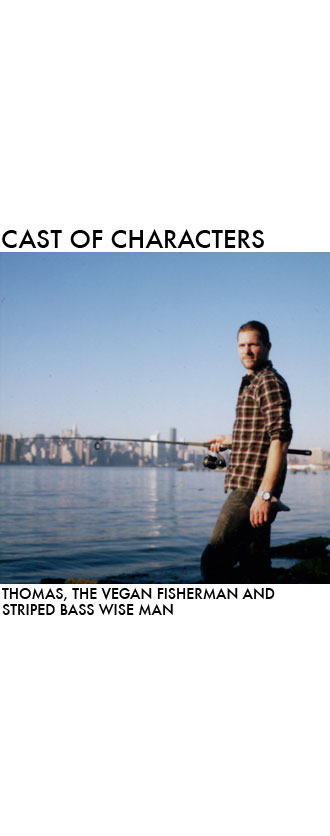
 I met Thomas, the vegan fisherman, at the Brooklyn pub after the weekly Sunday derby meetup. I had just finished an abbreviated interview with Ben, and even though the bells went off on his fishing rod, there was nothing on the line. The bar was too loud to continue recording, so I just relaxed and settled down with a pint of Brooklyn Pennant with Thomas and other derby members, including Maria, who helped Ben and Jamie Potter organize the derby. When I told her I still hadn’t caught any fish (she caught one the day I saw Ben filming himself Survivor Man style), she was incredulous. “Really?” she kept asking, between bites of a chicken taco. “REALLY?”
Thomas is a carpenter, born and raised in Williamsburg and often travels east to those same East End towns, Montauk and Southampton, for work or fish, or both. He is the aforementioned vegan fisherman who won’t eat ice cream, but will eat fish, a concession he makes by only eating fish he catches. When he’s not fishing out East, he’s fishing from his kayak in Jamaica Bay near JFK Airport. Thomas is a hardcore fisherman for striped bass, and he regards bluefish as a cannibalistic devil-fish. He told me he has trouble remembering people’s names, but “I can tell you when I caught this fish on the outgoing tide and I had a shore wind…”
“Well,” I said, tipping back another beer. “You know where your priorities are.”
“It’s a totally different way of life out East,” he told me. “Like I’ll go check out spots at lunchtime and I’ll just see van after van lined up on the sides of the roads. Every contractor in the area is there. They have a thing where they’ll say ‘Well, if I can get to it tomorrow, I will.’ Meaning if the fish are biting they won’t be there [to work].”
Like Greg, Thomas was very generous with his fishing knowledge. He pulled out 5-inch plastic lures from his tackle bag and told me they were his go-to lure, and said to fish them super slow, just enough to keep them from going slack in the water. He told me about using live eels, “like Twinkies for bass,” and when you feel the eel panic and jerk the rod before a bass strikes you have to “bow to the cow”—fisherman’s parlance for lowering the rod tip for a few seconds before setting the hook, and the hopes that there’s a big (female fish are bigger) bass on the other end. He recommended I check out a fishing video filmed underwater from a striped bass perspective of things. When his girlfriend at the time confronted him about the video he had to explain, “No, it’s called ‘STRIPERS Gone Wild,’ asshole!”
Thomas knew about the pier I was trying to reach. Earlier in the week he was looking for fishing spots for the derby and discovered a way to get closer. “You have to climb over this barbed-wire fence out over the water and run over some steel I-beams and junk but you can reach it,” he said. “It’s totally illegal and shit can get so shady back there sometimes. If there wasn’t other people fishing around there I definitely wouldn’t have felt safe. But I was getting hits on almost every cast out there.”
We made plans to meet up that week. With two weeks left in the derby, John’s fish was still far and away the leader. No one, it seemed, was going to catch him. I hadn’t even gotten a bite at this point, but with what Thomas told me and a new plan of action, I was getting closer.
I had to wait until Thursday for my work schedule to work with the tides since I wanted to fish at least two hours of high tide. I emailed both Jamie Potter and Ben the day before and told them about the mission. Both agreed to meet up, but by the time I was getting off work, I hadn’t heard from either. So it was going to be a solo night.
I arrived just after dark. It was pretty quiet and I could hardly hear the water moving up river. I climbed over the concrete barrier and untied the rod from my bike, surveying the route Thomas told me about. There was definitely a fence wreathed in both barbed and razor wire hanging out over the water, and the steel girders lead to a corner of demolished concrete. A light shone near the shoreline by the dock and there was an industrial yard of some kind beyond that. As I was plotting how I was going to ninja my way over toward the pier, a pair of bright lights blinded me and a gleaming white horse of a Range Rover roared up behind me and stopped at the barriers. Two guys got out, I couldn’t see them very well because of the flash of the headlights. One went around to the back of the car and started pulling something out. The other approached me and said, “Hey man, you doing some fishing?”
“No, not really,” I said, stupidly.
“Oh.” He walked around to the other guy, who was fiddling with something big and deflated looking on the ground. I could hear them talking, trying to put something together. Then I recognized the voice: it was Greg, and he and his friend had brought an inflatable 10-foot raft to launch into the river. “The other night we came here and caught about four or five, 30-inches or more on the other side of that pier,” he said, pointing to the empty, fenced-off shipping pier. I looked out toward the end of the pier, a few hundred feet out into the river where the current swelled and was ripping hard to the right, upstream. I looked at his half-inflated boat and his friend working the air compressor.
“Yeah, it’s a four chamber boat,” Greg laughed. “One of the chambers has a leak hahaha. But it’s designed to stay afloat with only one chamber fully inflated anyway so…”
I thought of what Robert told me that day in the tackle shop. Greg looked out toward the pier and said, “Boy, you can hear them jumping over there.” I looked, but didn’t see anything. We talked a bit longer while his friend finished inflating the boat, then Greg put the seats in and then the rods. We launched the boat from a skinny ledge of concrete and I held the boat steady while they climbed in. The water here was pretty calm, the current was definitely pulling but the surface was glass. Out there, beyond that pier the water was as restless as a hot summer night in the Favela. “Good luck,” I said as if they were taking off on a Three Hour Tour. As they rowed away with rubber paddles under the glow of the city on low hanging clouds I heard Greg say, “Boy, it’s a warm night out here.” A few minutes later as I was packing up my gear, I heard him yell, “Mike they’re jumping over here! See if you can get over that fence!”
 Negotiating the fence with a backpack and a fishing rod was easier than I thought it would be. I just had to make sure to step in the right spots, kind of like Indiana Jones in that temple before he gets chased by a giant boulder. I had to step between the razor wire wound along the bottom part of the fence, then swing my body around the five or so vertical strings of barbed wire, then step back through the razor wire, and then hop from the fence to a pile of concrete. From there it was a brisk walk through more demolished and, depending on the tide, submerged, concrete slanting in at interesting sharp angles, steel I-beams that were the sturdiest things in the area, and piles of weeds with hidden, or perhaps discarded strands of razor wire in the grass. But once you made it this far, you had your run of the small area. Some rocks were loose and would shift under your weight, but for the most part it was quiet except for the sound of water flowing under the pier and the snapping pops of fish punctuating the surface. I’d reached the prime rib of hobo fishing spots.
I rigged up with a 6″ Bomber lure my dad apparently had for a long time since it was beaten up by rocks and the paint had mostly chipped off. It’s one of those classic lures, a long and skinny torpedo-shaped shallow diver with a sort of wild wiggle pattern on retrieve. Considering I’d lost pretty much one of everything else, I figured why not this one. My first cast came back unmolested, though every minute or so a fish was jumping out close to the pier, taunting me. “If I can’t catch a fish here then I really have to retire,” I thought. I changed up the retrieve a little on my second cast and about 20 feet out I got a hit! Miraculous! I set the hook and it was on! Ever since I was a little kid I’ve had this type of background music that starts up whenever I hook a fish—it’s not very distinct as to be a kind of music or any particular song. It’s not the tournament montage music from Karate Kid. The only way I can describe this kind of awesome music is that it’s like the theme song from The Benny Hill Show played through an 8-bit Nintendo. The music was in my head now as I was fighting this fish. I had to pull the fish around a submerged piling and I could see its white belly flash in about three-feet of water. I managed to get the fish in a shallow pocket of water just below me. Finally, Christ, I thought. And at that moment as I reached down for its mouth, a quick flick of its head, the fish—about 18-inches—unhooked and with a snap of its tail I watched the gray shadow speed back toward deeper water. Still, I felt pretty satisfied.
I could hear Greg and his friend on the other side of the pier, their lines whizzing with every cast. I got a couple more hits on the Bomber before I accidentally cast it onto the pier. I jiggled the line a bit hoping to get the lure to hop back over to the water but no such luck. Reluctantly, I had to break off. I lost another Bomber up there shortly after. The action started to slow down, so I rigged up some clams, casted out, and waited. Fishing for me gets boring fast when using bait, bored enough that I began studying the pier and potential ways to get onto it to retrieve the lost lures. A fence extended out about 25 feet from the shoreline, was about 10-feet high and was liberally applied with barbed wire and razor wire. The more bored I got, however, the more daring I felt.
The pier for all intents and purposes was abandoned. It appeared to be an old shipping dock for a company that no longer existed. The water was very deep, as I’d later learn from Greg who was out there on that raft and tried to drop anchor with 100 feet of line and hit bottom with 20 feet left. The pier, destroyed and rotting away in places, had been rebuilt in other places for some indiscernible purpose. I managed to pull myself onto the dock and run to where I last saw the Bomber. Along the way I saw a few poppers and other lures and snatched those up too. I found the orange-bellied plug amongst some rotting wood and weeds. “Fuckin’ A, man. Awesome.” I hustled back to the shoreline and got snagged myself on razor wire on the top of the fence. Perched up there like a bird caught in fishing line. A pair of pliers I had in my back pocket plopped into the water as I tried to unhook myself. With surprising patience I freed myself and climbed down, noting that that was probably the worst way on and off of the dock.
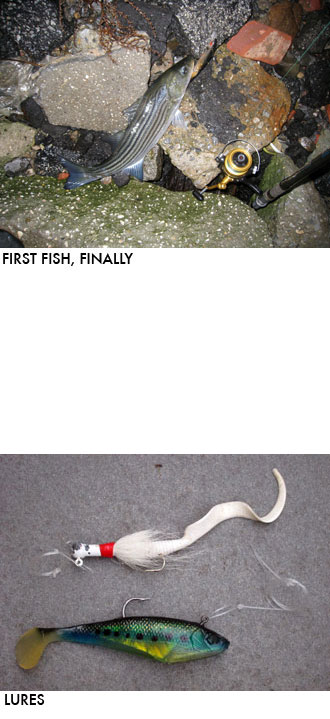 I went back to the dock for some dawn patrol on Halloween. I only had a week left in the derby to catch and submit anything and my girlfriend, with her infinite patience was starting to wonder what I was doing all those nights and hours spent fishing with no fish to show for it, coupled with the fact that while I was blowing off time with her, I was only a few blocks away, down some dark alley standing by the river and studying the water. I was over the fence and through the obstacles well before dawn. Like my last time here, fish were jumping all over, peppering the dark surface with short, quick splashes all around the pilings of the pier. Within two casts I hooked a little 20-inch schoolie and actually landed it. I was feeling pretty good, not so triumphant as relieved, while I admired its shiny gray and white body. I’d caught striped bass before, but this was the first time in a long time I’d worked hard at it and came up empty time after time. The feeling was like finally getting a solid win after an extended, pitiful streak of mediocre losses. I took a couple photos and quickly unhooked the fish and released it. Two casts later I had another hit, but when I set the hook I sort of yanked the fish out of the water and it landed back in the briny river a free fish. Then I lost my trusty orange-bellied plug on a piling in the water and felt a little depressed. The lure had so much history and had become my own go-to lure. I fished until the sun rose and figured hanging around in full daylight was a good recipe for getting busted, so I started packing up. The tide was going out quickly and I swore I saw something orange on a newly revealed piling. Two Polish guys showed up near the end of the driveway and were casting out clams. There was definitely something orange out there just above the water, stuck on a piling. I didn’t have much time, so I said screw it and snuck out onto the pier in the dawn light, leaned out off the pier and snatched my lure back from oblivion.
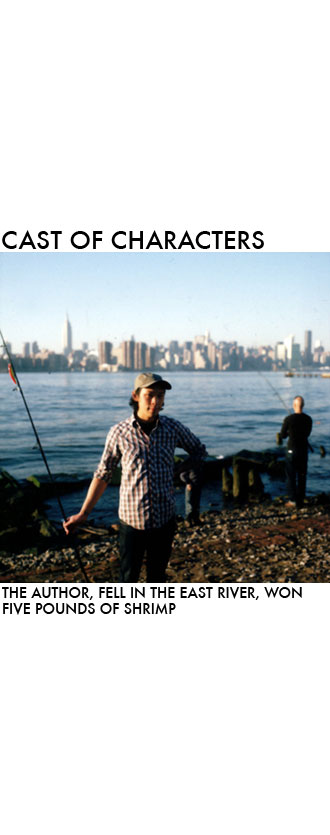
I finally hooked up with Ben, Jamie and their friend Mina a couple of days later. I was eager to show them the prime rib of hobo fishing spots, so I was careful to tell them the cautions and perils of the area. Unsurprisingly, I was the one who fell in the river that night. I was also the only one who caught any fish, but I lost my digital camera and my phone to the river. My first sensation after doing a front flip into the water was “Wow, this is really saltwater.” The first thing I said to my shocked companions was, “What expression did I have on my face when I got out?” That’s all I want to say about that night.
I went back the next night to get back on the horse and ran into Greg. Fish were jumping further out on the pier, near out of casting range. We needed a new plan and I mentioned a way to get up the pier. Of course, Greg already knew about it, but he’d gotten caught by a security guard the last time he was up there. With a word, however, he was back in. “Fuck it, man. Let’s do it,” he said. I was just beginning to realize his fearlessness. We were through the fence and sprinting toward the shadows with all our gear in less than two minutes. The pier was in various stages of repair and disrepair, as if it were condemned and then rebuilt just enough so the owners wouldn’t have to tear the whole thing apart. It still served no discernible purpose, just an empty pier, several hundred feet long stretching pointlessly into the river. We ducked down to a dropoff on the side of the pier, still covered by the shadows so we could see the shoreline well, but from the shore no one could see us. It was a nice tradeoff. We also didn’t see the guy already sitting in the corner and had in fact ran or jumped right past him. He was clearly not happy with us being there, aside from invading his personal space, he also seemed quite content to sit there in the dark by himself and fish. Greg tried to make some small talk with him, unsuccessfully. From here we could sit out on broken wooden planks, the river streaming under the pier beneath us. Fish were literally jumping right below our dangling legs, seeing their shiny black backs crest and then return underwater. There was a mix of striped bass and bluefish in the water and at times if we left the rubber shad lures dribbling just below the surface while we lit a cigarette or tied our shoes, a fish would hit it and almost pull the whole rig in.
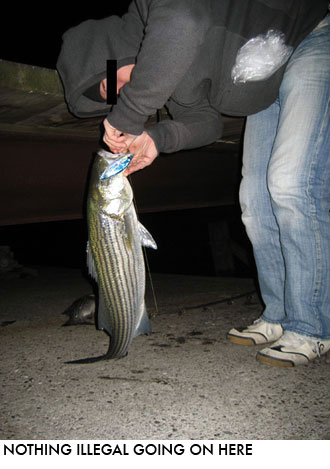
“You guys want to have some fun?” the guy said. “Go down to the end of the pier. That’s where the big fish are.” We took the hint and grabbed our gear and made our way toward the end. The pier was sketchy, not only for the security and old and new planks sagging and booby trapped rotten and soggy, but also for holes hidden by the dark into which you could jump down right into the water and probably die. The end of the pier turned into concrete, part of which for some reason was leaning into the water like a ramp, rolling back toward the shoreline. The rebuilt part of the pier was built over this angled section to keep the surface level even, which created a kind of sideways lean-to with the concrete underneath the planks. Out here the water ran faster and deeper, a constant sound of a drain for some reason. With so much water around and us sitting literally in the middle of the river there was little need to cast. Instead we pitched out 10 to 15 feet and let the current take the lure under the pier, retrieved slowly and jigged. We caught four legal bass in the space of about 45 minutes, alternating catches, one bigger than the last. Greg promised fish to some guys who worked for him, so he’d unhook the fish and just toss them under the pier onto the concrete, where they’d lay wide-eyed and staring. Occasionally they’d flop around and try to find water again. When they got close, Greg would pick them up and toss them up higher on the ramp. The wind was picking up and the tide that was rushing under us just an hour earlier was starting to slack. Greg pulled a clear plastic bag out his sweatshirt pocket and we tossed the fish in. The bag was heavy with fish. We walked casually back to the shoreline. We were through the fence and gathering our things when we heard him. The security guard was apparently waiting for us to come back. “Hey,” he said, as we pretended we didn’t hear him and kept walking. “HEY!” Then he was talking to Greg. “This is not the first time I’ve seen you here, is it? We’ve met before.”
“Yeah, last week,” Greg admitted.
“Next time I call the police.”
“Okay, we’re leaving, we’re sorry.”
As we crossed the demolished concrete slabs Greg explained, “That guy is alright, but his boss is a hardass. I gotta talk to that guy’s boss. Maybe tomorrow.” I was reminded of a line from the movie Sexy Beast: “Where there’s a fuckin’ will, there’s a fuckin’ way. And there is most definitely a fuckin’ way.” That about sums up Greg’s mentality when it comes to fishing.
 I went back out to the pier with Jamie Potter the last night of the derby. I’d fished with him for several days that week, and he was getting very desperate because he still hadn’t caught a fish. I promised him a fish that night on the pier. We settled down at the second drop off of the pier. The night was warm and fish were still jumping, their dark shadows and dorsals humping through the water below us, so the signs were good. About thirty minutes in, Jamie hooked a fish near the surface. I watched in awe as he was so excited and anxious instead of fighting the fish he was trying to yank it straight out of the water. “Wait dude wait! Let it fight!” I shouted in a loud whisper. Maybe he had that same 8-bit Benny Hill song in his ears, because he kept yanking on the fish and quickly yanked the lure out of the fish’s mouth. Then it was quiet, like after a loud and public argument. “Goddammit,” he said, reeling in.
Jamie was pissed off. He was casting out and reeling in as fast as he could cast. “Dude, you need some patience,” I said, laughing.
“It’s easy for you to say, Mike!” he yelled. “You’re not one of the organizers of this thing. When people ask you, ‘Oh, how’s the fishing?’ ‘What are you guys catching out there?’ You can’t just say, ‘Oh gee, I don’t know.'”
I laughed. It was a frustration I was getting to know well myself, and I knew that just because I had caught some fish and broke the streak, it didn’t mean I wouldn’t hit another dry spell.
“I can’t fish for fish anymore,” Jamie said finally.
“Ok, well what do you want to fish for?” I asked.
“Beer,” he said. “Let’s make a bet.”
“Ok.”
“First person who catches a fish. The other guy has to buy him a six pack.”
“Ok,” I said, smiling.
“What kind of six-pack though?”
“Winner’s choice,” I said, feeling a little confident.
“Ok, it’s on.”
I casted out a few more times, then gathered up my gear. “I’m going to the end of the pier,” I said. “Do you want to come?”
“Nah,” Jamie said, still bitter over losing that fish and determined to catch it again.
I ran down to the end of the pier and sat down on the concrete ramp where Greg and I fished a few nights before. I was going to win this bet. I casted out to my left and let the current pull the shad under the pier. On my second cast there was a solid hit, the lure with all the current and retrieve stopped like someone had grabbed it. I set the hook and struggled for a few minutes to keep the fish from diving too deep under the pier and soon landed a nice 26-inch striper. I pulled my phone out of my pocket and texted Jamie. “Hey can I borrow your camera for a minute. Haha”
A few minutes later he responded. “Damn you!”4
I took a couple quick photos and released the fish. Jamie sat down next to me, grumbling a little. I told him to switch to a shad since I had some good success with those here and he did, tying a white one on. A few casts later I caught another fish, just under his line. Another small one, about 24-inches long, but a fighter. “That’s two six-packs you owe me,” I said. Ten minutes later I caught another fish in the same spot. By now I was really laughing and Jamie was getting a little annoyed at me for wanting him to take my picture with a fish every few minutes. I was actually rooting for the guy; I wanted him to catch a fish but for some reason I was beating him to it. “That’s three six-packs!” I said. That didn’t help his mood.
I caught a fourth fish a few minutes later. This time I set the hook and shoved the rod into Jamie’s hands. “Reel this one in,” I said, starting to feel a little bad. I wanted him to get a feel for the fish, how to let it fight and let the drag do the work, and, most importantly, not to just yank the fish out of the water. It was a small fish so we didn’t bother measuring it. I grabbed another shad out of my tackle bag and tossed it to Jamie. “Dude, you gotta change to this one,” I said. Watching me hook four fish in a row convinced him. It worked, or something worked for him, because ten minutes later after some Fishing With John-style chatter I noticed he was silent. I was still watching my line and looked to my right. His rod was bent toward the water. He’d finally hooked one and was fighting it to the surface. I reeled in my line so it wouldn’t get caught up in his and cheered him on. After a good little fight, we pulled in a nice, fat 28-inch bass—his first one. We took a few shots of the successful fisherman. You should have seen the smile on his face.
The last day of the derby was a warm afternoon for November. We gathered at the park shore as usual and with the nice light and the end of the derby party coming in a few hours, everyone was in a pretty good mood. I was feeling very lazy; very lazy fisherman. It may have been because I knew the park was not really good for fishing and that I knew John Ruffino was going to win easily, but it also may have been because I subconsciously didn’t want to lose anymore lures, as I’d lost a lot of lures here over the past month. I just wanted to relax, shoot photos, and throw out the occasional cast. Jamie was happily showing everyone the photos of his fish from the previous night and I was feeling pretty satisfied with the last week of fishing. The warm weather drew lots of people to the shoreline. Little kids obliviously running behind casts and throwing rocks into the water, their parents not paying attention or busy talking with other yupster5 parents, also not paying attention to their kids. It was a good day to be in the sun and it shone off the water like the shimmering scales of the fish we weren’t catching (I was thinking of everything in terms of fish or fishing at this point).
As the sun began to set the park staff started the arduous task of kicking everyone out of the park, many of whom had showed up just to watch the sun set. That bought us some more time and I looked up and suddenly saw the sky full of birds diving into the water. I rigged up the old beat-up trusty Bomber and made a long, high-arcing cast toward where the birds were diving. I almost thought it was a bad idea and it was. It turned out the birds were only diving because some kids were throwing bread into the water. And also because a seagull dove after my lure and got caught in my line. The bird sat there in the water, its leg tangled in fishing line, my old faithful lure on one end and me on the other end. I pulled on my line a little bit, trying to free the bird but succeeded in only dragging it across the water and pissing it off more and getting it more entangled. I could hear people behind me talking. “Why is he messing with that bird?” “He shouldn’t have casted out there.” Reluctantly I took out my knife, rather than risk untangling a dumb bird in front of a crowd of self-righteous parents and their kids who would inevitably start crying. I cut the line and watched the lure drift toward the middle of the river, and the bird in another direction. The same lure I’d snatched back from the land of lost plugs so many times, the same one my father used for ten years in Delaware. It’s weird to admit to being bummed about something plastic as if it were capable of significance beyond sentiment—I could easily just buy another. But as I watched it float further and further away, out there in so much water, I couldn’t help feeling a little lost. I didn’t care much for the bird though.
4Ben awarded Jamie the “Most Jealous Fisherman” award at the end of the derby.
5Hipster + Yuppie = Yupster
