Brief Interviews with Hideous Men
21.10.09
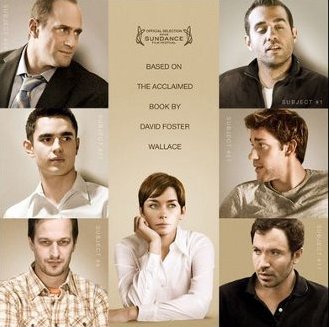 Stanley Kubrick remarked of his adaptation of Lolita, “If it had been written by a lesser author, it might have been a better film.” Through exquisite prose and writing style, revered authors like Nabokov evoke an emotional response that is essentially untranslatable to the screen. This, in addition to the prestige of the author, heightens the expectations placed on such an adaptation; the film has to be successful in its own right while capturing the essence of the original work. Thus in the wake of David Foster Wallace’s suicide, the task of adapting his work is particularly daunting. He’s not only one of the most venerated post-modernists in America, but one whose untimely death still haunts the literary world. John Krasinski’s recent adaptation of Brief Interviews with Hideous Men attempts to recreate Wallace’s complex, experimental story but ultimately fails to deliver the brilliance of Wallace’s writing.
John Krasinski’s film dramatizes the series of interviews chronicled in Wallace’s short story. The ambitious adaptation follows Sara Quinn [Julianne Nicholson], an anthropology PhD candidate, as she conducts interviews with men for her dissertation on female sexuality. The movie juxtaposes her formal interviews with scenes from Sara’s personal and professional life, in which she effectively “interviews” male acquaintances on subjects relevant to her work. After her recent estrangement from her boyfriend, Sara uses the interviews as a means of exploring her abandonment.
Wallace’s story, divided into four shorter pieces interspersed throughout the collection of the same title, documents the transcripts of men identified only by interview number, location, month, and year. The subjects converse with an amorphous interviewer, whose questions and remarks are omitted and replaced with “Q.” followed by a blank line. In some of the interviews, the reader has a sense of a distinct female interviewer. The multiplicity of the interview locations, however, as well as the varying relationships between the interviewer and subject, does not necessarily suggest a common interviewer throughout the piece.
The power in Wallace’s story lies in the relationship between the details provided and those intentionally omitted. The subjects have strong, distinct voices, which the reader utilizes to construct their characters. The reader also effectively assumes the role of interviewer by inferring the interviewer’s questions through the subject’s responses. This creates an intimacy between the reader and the text in which the subjects appear to speak directly to the reader.
At the end of the story we still do not know who the men and the interviewers are, nor the purpose of the interviews. Herein lies the main distinction between the film and short story—the relationship between the work and the audience. While all of the interviews in the film are verbatim, or abridged versions of the interviews in the story, less creative responsibility is placed on the viewer. We understand why Sara embarks on the interviews and what she accomplishes by the end of the film. While we know little about the lives of subjects, we know their appearance, age, and ethnicity. In the “interviews” with the men from Sara’s life, we understand precisely who the subjects are, as well as their relationship to Sara. Although the spare dialog Krasinski added to make these interviews function as scenes flows seamlessly into Wallace’s lines, the characters he constructs function only to facilitate the “interviews” that Sara holds with them. The viewer subsequently contextualizes these men in response to their attitude towards Sara, deflecting attention away from the power of the monologues themselves. These additions and adjustments diminish the unsettling aura of Wallace’s narrative fostered through the pervasive anonymity employed within the piece.
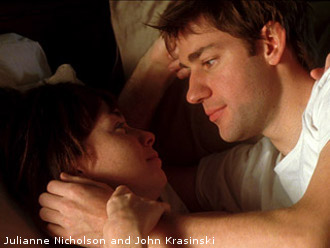
Both the film and story end with B.I. [Brief Interview] #20. In the film, B.I. #20 is personified as Sara’s ex-boyfriend, Ryan [John Krasinski]. After watching Sara indirectly search for an explanation for Ryan’s betrayal, Ryan reveals why he left her for another woman. The movie builds up to this interview and, once we witness it and realize that he too is a “hideous man,” her work is complete. This pat ending enables viewers to leave the film confident that they have understood its message.
While B.I. #20 also appears as the final interview in the story collection, its intent is not as overt. Wallace doesn’t imply that the subject and interviewer have dated. The interview does not clarify those preceding it. It is difficult to know what to make of the B.I. #20, other than that it is poignant and inescapably disturbing. At the end of the monologue, B.I. #20 says, “end of story.” Since this interview doesn’t explain or contextualize the other interviews, the reader is left with the clear sense that this is not the end of the story and that, in some form, men will continue to be “hideous.”
The difference in tone and intention in the final interviews elucidates the primary distinction between the two pieces. Krasinski diminishes the mystery central to Wallace’s story. Some of this is unavoidable; without Sara’s central storyline, the movie would have been too episodic. Even if Krasinski had kept the interviewer anonymous, he needed to depict the subjects; otherwise, we would have been staring at a black screen. But in watching the rendered subjects, the viewer links the monologues to the characters, thereby fixing each interview within a predetermined context.
As Kubrick acknowledged in his assessment of Lolita, adaptations of remarkable literature are difficult. There are moments, such as the scene in which a subject confronts his shame over his father’s work as a bathroom attendant, where Krasinski’s film is exquisite. But despite the film’s ambition, it fails to capture the genius of Wallace’s story. This is exacerbated at the end of the film when the epitaph, “The truth will set you free. But not until it is finished with you. —David Foster Wallace” lingers across the screen. The viewer subsequently contextualizes the film within the memory of David Foster Wallace. Although it’s necessary for Krasinski to pay homage to Wallace, the epitaph serves as a reminder that the film is an adaptation, one that doesn’t quite do justice to its origin.
Related Articles from The Fanzine:
Steven Soderbergh’s The Informant!
The Little Prince of Purple Rain
Scott Bradley on The Hurt Locker
