Sh…
01.04.06
 Even before my older sister Lisa died, even before she got sick, I watched a lot of horror movies. They cost me sleep so if I had any sense, I wouldn’t like them as much as I do. But I do.
Mainly it’s the monsters. Not the slaughters they accomplish or how much and loud they make people scream but how powerful they are. And their back-stories, the stuff about what made them monsters in the first place. Like Jason Voorhees, from Friday the 13th. Before putting on a goalie mask and macheteing people, he was a camp kid who’d drowned because his counselors were off making-out in the woods while he was trying to swim. And Freddy Krueger in Nightmare on Elm Street, his story’s actually pretty complicated.
Freddy was evil even before he died. He molested children. But before that, he’d been a baby whose mother was a little girl who’d been locked in a sicko asylum by accident. After the vigilantes had burnt adult Freddy to death for touching their kids (which you only hear about, it happened before the first film), he comes back from the grave, looking bad-ass. His face is melted, it shows big patches of the sensitive red under his skin, and he wears a slouchy hat and a glove that has ten-inch knives for fingers. He’s back to haunt and kill, but he doesn’t fuck with the people who lynched him, and not the psycho possible dads who raped his mom either. He stalks the children of the people who lynched him. And in the sequels, he goes after later generations of kids who try to grow up on Elm Street.
I know that sounds strange—that those kids get killed without even being relatives of the original angry mob. But if you think about it, living on the same street is a kind of being related. It’s like the way that all Jason’s camp counselors are related, one summer’s counselors being like the children of the same camp’s counselors from summers before.
What Freddie and Jason ultimately want to do is to stop the whole Elm Street and Camp Crystal Lake systems from continuing. Or they want to make more monster ghosts, I don’t know why. Maybe for company, or help. The films never actually say that Freddy or Jason’s victims turn into monsters after dying, but I’ve always figured that could be a marketing thing. A good monster is what makes a film popular and, once the movies have one, they don’t want to distract people with every logical spin-off. If each slaughtered kid though actually does turn into his own undead monster, it works out to be a kind of Blob Tag. One by one all the kids die, then haunt and kill. They become one big It.
After Lisa came home from the hospital, the doctors had said nothing serious was wrong with her but she still had to take meds. Every four hours. For being tired all day—more tired than before she went to the hospital I thought. Also her chest still hurt, which kept her from sleeping. She would do this thing that was like hyperventilating but quieter and, instead of passing out, her face would get dark and red. It could happen to her just whenever. Mostly at night, she said, but sometimes during the day, which I would see. Like, over breakfast. We’d be at the table and she’d be pouring sugar on her cereal one minute. Then I’d look up and she’d still be holding the sugar but staring into space, looking intense. Changing colors. She said that when that happened she had to think hard about breathing.
I started watching more movies than ever then.
 Lisa couldn’t take her pills without water and, if she brought a cup into her room when she went to bed at night, four hours later it was too dusty to want to drink from. There’s tons of dust in the air of a room, especially bedrooms. It doesn’t matter how clean you keep the room. I vacuumed every day after school, dusted and did windows on Saturdays. A couple times when I was done I tried putting out a glass and, sure enough, in no time at all—particles appeared in it. With all that invisible uncatchable dust flying around, Lisa had to get out of bed and go to the bathroom to get fresh water to take her meds with. Crossing the hall in the middle of the night sounded like lonely work to me so I started going to her room to remind her. I’d go with her and watch her swallow her pills.
At first I went to bed like normal and set my alarm like normal but for three in the morning instead of seven-thirty. When it woke me though, I got way too disoriented. I wouldn’t remember where I was or what was going on or what I had to do. I’d dress for school before I saw it was still dark out and actually read the time on my clock. Then I’d be standing in my bedroom, in my school clothes, and remember Lisa. I’d feel bad all over again that she was sick. And bad that I’d slept and forgot when she couldn’t.
After too much of that, I just stayed up until it was time by watching movies. I dropped off midway through a few but not usually. Usually I made it to the end of the credits. Then I’d head upstairs, brush my teeth, and check on Lisa last thing I did. Those nights Lisa and me both would be totally beat together. We’d stumble back and forth to and from the bathroom and wouldn’t talk much. We giggled if one of us couldn’t walk straight, and once she said I looked zombie-eyed to flatter me, but that was about it.
Her chest kept hurting her when she got off the meds though so I kept checking on her. By that time I’d gone through everything that looked even decent in the video store’s Horror section and moved onto Cult Horror, which is pretty hit-and-miss.
Freaks turned out to be a hit. Really scary. It’s in black-and-white, which makes it seem super authentic, like something from the school library, made by the same people who do the films about old wars. What happens in it is the midget twins and their friends the bearded lady and the harmonica-playing human skeleton and the legless-armless man get duped and robbed by the muscle-man and the trapeze artist—who’re both normal and sexy (they’re in the circus because they’re talented). And the freaks get revenge at the end. They turn the trapeze woman into a bird freak by cutting off her legs and tar-and-feathering her torso. While it’s happening, you root for the freaks, but when it’s over it really disturbs you because you realize everyone in it’s evil and all of them are just human beings the whole time. The freaks in Freaks aren’t monsters at all, just ugly circus people, made-up no more than any of the other actors.
(At one time I thought not devising new freaks was lazy of the producers or writers, but now I give it to them for being practical. Take the legless-armless man. A handsome, unfreaky actor would’ve charged them more, then had to learn the part, and the studio would have had to dump more time and money still into making stage-magic furniture for limb-hiding and such. Meanwhile the real legless-armless man, who likely had at least some drawing power—moviegoers must’ve heard of him—he probably spent his circus off-seasons otherwise just laying around getting depressed, turning the classifieds with his teeth.)
Army of Darkness was a Cult miss. That turned out not to be Horror at all. Some people think walking skeletons are enough to make a movie Horror but they’re not. It’s about a modern K-Mart kind of hardware salesman who gets stuck back in time and has to fight a whole medieval cavalry of undead, practically everyone who’d died up until then. It’s a comedy because he has to take them down with a chainsaw and a shotgun. Probably a good laugh too if you’re into mixing-up eras humor.
I wanted to be useful, I wanted to do whatever I could for Lisa, so when I checked on her after the meds stopped, I refilled her vaporizer. The doctors said it might help but I don’t think it did much more than make everything damp. Since she was always tired, I felt bad about going into her room when she was trying to sleep. My compromise was to be quiet about it. I went in on tip-toes and memorized the floorboards that didn’t squeak, it was kind of hop-scotchy. Lisa thought she was pretty funny though and, just when I had the vaporizer in my hands and was going out, closing the door most of the way with my foot, she’d say, “Hi.”
I’d say, “Hey,” and she’d say, “Sh. I’m sleeping.” I’d nod, “Okay.”
Then when I came back in with it, after I’d tip-toe jumped across the room, balancing the vaporizer full of water, and put it down, plugged it back in, and made sure it wasn’t pointed at her bed, she’d say, “Hi,” again.
I’d say, “Hey,” and she’d ask me, “Whatcha doin?”
Sometimes I said,” Filling up your vaporizer.” Sometimes, “Sleeping,” which had made her laugh the first time I’d said it. And sometimes I said, “What’s it look like I’m doing?”
Then she’d say, just pretending to be frustrated I think, “I don’t know. I’m sleeping.” But her eyes would’ve been open since I went in, even before she first said, “Hi.” I could’ve sat on the end of her bed and said more or just watched her, but I didn’t want to get in the way of her trying to sleep.
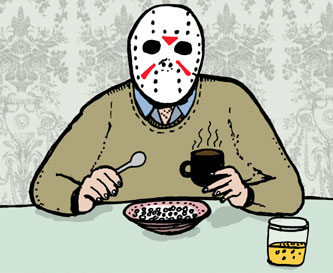 Sometimes before she died, Freddy or Jason would be at breakfast with us. Whichever of them it was that time would sit opposite me at the table, with Lisa in between, in her usual seat. He’d have his own bowl of cereal but Lisa would never pass him the sugar. Neither of them ever asked or said anything, but when she’d pass it to me, he’d reach out across the table and grab for it.
Normal mornings I spread my sugar out all over my cereal, but when one of them was there, I’d end up piling up a big silver mound in the center of my bowl. Not because I was scared, those breakfasts were just so strange I’d lose track of what I was doing. When I was done sugaring, Freddy or Jason would look at me, to get the sugar next, all, “Please please please?” I’d look at Lisa because she was older, but she’d keep eating. Then she’d slide the sugar back, close to her side, with her free hand, without looking up.
I’m always in a hurry to make the bus, so I’d have to forget about Freddy or Jason and focus on eating. I’d eat as quick as I could until the dripping started, which I always forgot was going to happen until it happened. Until I heard the drips. Then I’d see that, if Jason was with us, he’d’ve been trying to eat but couldn’t get the spoon in through his hockey mask and was spilling milk and soggy Os or nut-clusters all over. With Freddy it’d be the same thing except he spilled because it’s too hard to use a spoon with finger-knives and he’s very right-handed. His spoon would tilt at messed-up angles. Either way, at that end of the table, cereal splatters. Puddles of milk running off the side onto the floor. I’d stop eating and start worrying about whether I could clean up the mess before the bus came. I would either still be looking at the milk, at the puddle growing, covering the floor under the table and spreading toward the walls, or I’d be looking at the clock, which just kept ticking time, when the bus honked.
Then after Lisa died, sometimes at night I’d be on the couch in front of the TV or in my bedroom, either way doing nothing special at all, when I would stop and know that someone was in another room in the house. Not Freddy or Jason or anyone I knew, but an evil mailman or a security guard from the grocery store down the block who’d gone suddenly nuts. Since I couldn’t risk moving to hide or lock my door—it might call whoever it was’ attention—I’d have to sit still until I knew that he had left. He usually only took forty-five minutes or an hour to finish doing whatever he was doing, checking drawers or trying on clothes to disguise himself, but it was still scary for me even after he left because I’d have been thinking that, if he found me, he’d kill me, and I’m scared of dying.
